How Long Is 25 Feet Length? 15 Real-World Comparisons

Twenty-five feet is exactly 300 inches, 8.33 yards, or 7.62 meters. It is also 762 centimeters and 7,620 millimeters. Visually, 25 feet is slightly longer than a regulation soccer goal’s 24-foot width and close to the width of two 12-foot traffic lanes.
You may encounter a 25-foot measurement while planning a room, choosing an extension cord, buying a garden hose, arranging retail displays, or checking whether a large object will fit in a space. Yet a number on a plan can be difficult to picture without a familiar reference.
This guide explains how long is 25 feet length in both imperial and metric units. It also provides practical comparisons, measurement instructions, design applications, and honest notes about which examples are exact and which are approximate.
Key Takeaways
✅ 25 feet equals exactly 300 inches or 7.62 meters
✅ It also equals 762 centimeters, 7,620 millimeters, and 8.33 yards
✅ A regulation soccer goal is 24 feet wide, only 1 foot shorter
✅ Two 12-foot traffic lanes have a combined width of about 24 feet
✅ Ten average 2.5-foot strides can approximate 25 feet
✅ Real rooms, vehicles, trees, and driveways vary and should be measured directly
How Long Is 25 Feet in Inches, Meters and Centimeters?
The international foot has an exact metric definition. One foot equals precisely 0.3048 meter, so multiplying 25 by 0.3048 gives exactly 7.62 meters. NIST identifies 0.3048 meter as the exact international-foot conversion.
| Unit | 25 Feet Equals | Calculation |
|---|---|---|
| Feet | 25 ft | Base measurement |
| Inches | 300 in | 25 × 12 |
| Yards | 8.333 yd | 25 ÷ 3 |
| Centimeters | 762 cm | 25 × 30.48 |
| Millimeters | 7,620 mm | 25 × 304.8 |
| Meters | 7.62 m | 25 × 0.3048 |
| Kilometers | 0.00762 km | 7.62 ÷ 1,000 |
| Miles | Approximately 0.00473 mi | 25 ÷ 5,280 |
The inch, foot, yard, centimeter, and meter values are useful in different situations.
Builders and homeowners in the United States commonly use feet and inches. Designers, engineers, manufacturers, and most international markets normally use millimeters, centimeters, or meters.
For a quick conversion:
- Multiply feet by 12 to calculate inches.
- Multiply feet by 30.48 to calculate centimeters.
- Multiply feet by 0.3048 to calculate meters.
- Divide feet by 3 to calculate yards.
These conversions describe the same physical distance. Only the unit changes.
[Image: horizontal conversion diagram showing 25 feet, 300 inches and 7.62 meters]
Alt: “How long is 25 feet length in inches, centimeters and meters”
How Big Is a 25-Foot Length in Real Life?
A 25-foot length is long enough to span a large living room, a short garden area, a compact event display, or much of a residential driveway. It is not an unusually large outdoor distance, but it can feel substantial inside a home or store.
The visual impression also depends on orientation.
A horizontal 25-foot distance may look manageable across a driveway. The same measurement viewed vertically is approximately the height of a modest two-story structure, although actual building heights vary considerably.
You can picture 25 feet as:
- A 25-foot tape measure extended fully
- Five 5-foot sections placed end to end
- Ten strides of approximately 2.5 feet each
- A 24-foot soccer goal plus 1 additional foot
- Two approximately 12-foot road lanes plus 1 foot
- One-half of a 50-foot garden hose
The table below separates exact references from approximate ones.
| Comparison | Typical Measurement | Difference From 25 Feet | Accuracy |
| Contractor tape measure | 25 ft | 0 ft | Exact labeled length |
| Five 5-foot boards | 25 ft | 0 ft | Exact if boards are measured |
| Half of a 50-foot hose | 25 ft | 0 ft | Exact nominal half |
| Regulation soccer goal width | 24 ft | 1 ft shorter | Standard-based |
| Two 12-foot traffic lanes | 24 ft | 1 ft shorter | Common road reference |
| Five 5-foot benches | 25 ft | Variable | Approximate |
| Four 6-foot refrigerators | 24 ft | 1 ft shorter | Approximate |
| Ten 2.5-foot strides | 25 ft | Variable | Personal estimate |
| Compact RV or shuttle | 20–25 ft | Varies | Model-dependent |
| Residential flagpole | 20–25 ft | Varies | Product-dependent |
15 Things That Are 25 Feet Long or Close to It
The following comparisons are meant to create a reliable mental picture. Objects described as “approximately” 25 feet should not be used as precision measuring tools.
1. A Fully Extended 25-Foot Tape Measure

A tape measure labeled 25 feet provides the most direct visual reference.
Extend the blade over a flat surface and secure the hook at the starting point. The 25-foot mark indicates 300 inches or 7.62 meters from the hook, subject to the tool’s calibration and hook design.
This comparison is more dependable than estimating from vehicles, furniture, or buildings because the tool is manufactured specifically to represent measured distance.
A 25-foot tape is useful for:
- Measuring rooms
- Checking wall lengths
- Planning flooring
- Positioning furniture
- Estimating fencing
- Measuring retail displays
Do not extend a metal tape near electrical wires, and avoid allowing a long blade to retract uncontrollably.
2. Five 5-Foot Boards End to End

Five boards measuring exactly 5 feet each produce a combined length of 25 feet when placed end to end without gaps.
This is useful in workshops and construction settings because it divides the full distance into equal modules.
The same method works with:
- Five measured ropes
- Five 5-foot tables
- Five marked floor sections
- Ten 2.5-foot sections
Check whether the stated board length is nominal or actual. Building materials may be sold under nominal dimensions that do not describe every finished dimension.
3. A Regulation Soccer Goal Plus One Foot
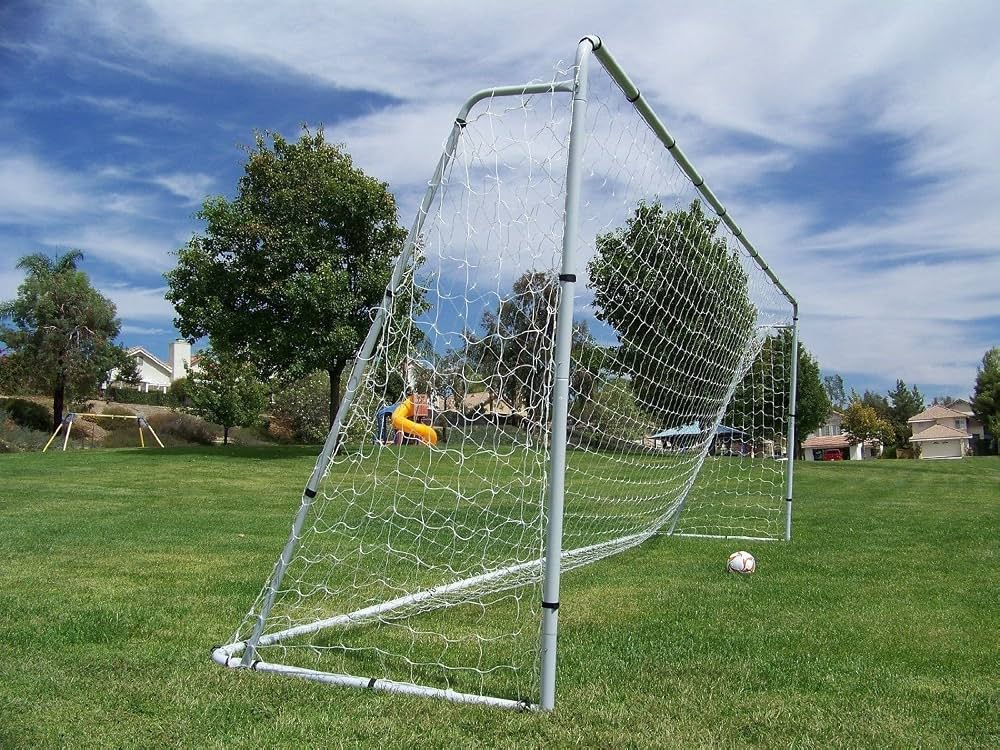
The distance between the inside edges of a full-size soccer goal’s posts is 7.32 meters, or 8 yards. Eight yards equals 24 feet, making the goal exactly 1 foot shorter than 25 feet.
Stand facing the goal and imagine adding a 12-inch section to one side. The resulting span is 25 feet.
This is one of the strongest standardized comparisons because the goal width is established in the IFAB Laws of the Game rather than estimated from an average product.
4. The Width of Two Traffic Lanes

Two 12-foot lanes placed side by side have a combined width of 24 feet. Add 1 foot to visualize 25 feet.
The Federal Highway Administration notes that 12-foot lanes are used or desired in several major-road and large-vehicle contexts, although real lane widths can differ by road type and location.
Never enter a roadway to measure it. Use this comparison only as a visual reference from a safe position.
Road shoulders, medians, markings, bike lanes, and curbs are not included in the basic two-lane calculation.
5. Half of a 50-Foot Garden Hose
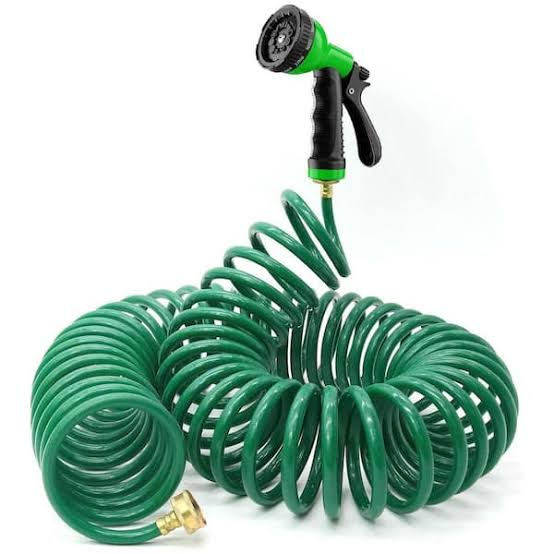
Garden hoses are commonly sold in labeled lengths, including 25 and 50 feet. Half of a nominal 50-foot hose represents 25 feet.
This comparison is helpful because a hose can follow a path around plants, furniture, corners, or outdoor fixtures.
However, a coiled hose does not show its reach clearly. Lay it in a straight line if you need to understand the full distance.
Remember that usable reach may be slightly reduced by:
- Connections
- Bends
- Obstacles
- Elevation changes
- The need to avoid pulling the hose tight
6. A 25-Foot Extension Cord

A cord sold as 25 feet long provides another familiar reference.
Its practical reach may be less than 25 feet because part of the cord must connect to an outlet and part may need to route safely around furniture or equipment.
For space planning, distinguish between:
- The cord’s labeled length
- Straight-line distance
- Routed distance around obstacles
- Safe working reach
Do not stretch an electrical cord tightly across a walkway. The length comparison does not replace electrical-load, indoor-use, outdoor-use, or safety ratings.
7. Five Park Benches Approximately 5 Feet Wide

Many small and medium benches are around 5 feet wide, although exact dimensions vary by model.
Five such benches placed edge to edge would cover approximately 25 feet. Gaps between the benches would increase the total installation width.
This comparison can help with:
- Event seating
- Garden layouts
- Waiting areas
- Public-space sketches
- Retail rest zones
Always use the manufacturer’s specifications when planning a real installation. Armrests, legs, access space, and required circulation can make the final footprint much larger than the seat width alone.
8. Four Tall Refrigerators Stacked Vertically

A tall refrigerator can be close to 6 feet high. Four units of that approximate height would reach about 24 feet, which is 1 foot below 25 feet.
This is only a visual comparison. Refrigerator dimensions vary widely, and appliances should never be physically stacked for this purpose.
The example is useful for understanding vertical scale. It demonstrates why 25 feet appears moderate on the ground but substantial when viewed upward.
9. Ten Average Walking Strides

If your natural stride is approximately 2.5 feet, ten strides cover roughly 25 feet.
A stride means the distance from one heel contact to the next contact of the same foot. People sometimes count individual steps instead, which can produce confusion.
Your result depends on:
- Height
- Walking speed
- Terrain
- Footwear
- Age
- Whether you count steps or full strides
Calibrate your pace over a measured 25-foot line before using it for rough estimates elsewhere.
10. A 25-Foot Residential Flagpole
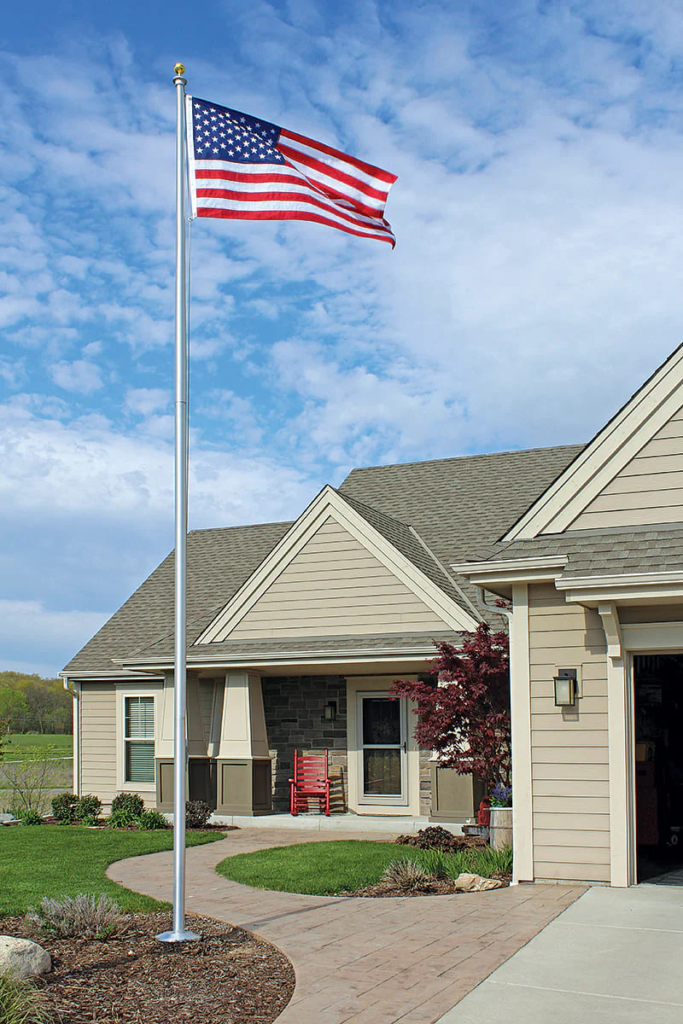
Residential flagpoles are available in several sizes, and 25 feet is a commonly marketed tall residential option.
A pole of this length provides a direct vertical comparison, but the visible installed height may be lower if part of the pole sits inside a ground sleeve or foundation.
Before installing one, check:
- Local planning rules
- Homeowners’ association requirements
- Underground utilities
- Overhead power lines
- Foundation specifications
- Wind-rating requirements
The product’s stated pole length and its finished height above ground are not always identical.
11. A Compact Motorhome or Large Camper Van

Some recreational vehicles approach 25 feet from front to rear, although vehicle classes and model lengths vary.
A 25-foot vehicle would equal 7.62 meters before allowing extra space for mirrors, racks, towing equipment, open doors, or maneuvering.
For parking or garage planning, the vehicle’s body length alone is insufficient. You also need:
- Width including mirrors
- Overall height
- Turning clearance
- Door-opening space
- Front and rear access
- Roof-equipment clearance
Use the exact manufacturer specifications for a specific model.
12. A Small Shuttle or Passenger Bus

Some small shuttle vehicles fall near the 20-to-25-foot range.
This gives a useful road-scale comparison, but there is no single universal shuttle length. Seating capacity, chassis, accessibility equipment, luggage storage, and manufacturer design all affect the dimensions.
A vehicle described as a “25-passenger shuttle” is not necessarily 25 feet long. Passenger capacity and physical length are separate specifications.
13. A Medium Recreational Boat

Many recreational boats are sold using approximate length categories near 25 feet.
Boat measurements require care because “length overall” may include hull projections, platforms, bowsprits, motors, or other components depending on the stated method.
When planning storage or trailer space, confirm:
- Hull length
- Length overall
- Motor position
- Trailer tongue length
- Width or beam
- Total height
- Clearance for launching
A “25-foot boat” and its complete trailer combination can require considerably more than 25 feet of storage.
14. A Large Room or Studio

A room measuring 25 feet along one wall is 7.62 meters long.
That can be a large living room, studio, classroom, showroom, conference area, or combined open-plan space.
Floor area depends on the second dimension. For example:
| Room Dimensions | Floor Area |
| 25 ft × 8 ft | 200 sq ft |
| 25 ft × 10 ft | 250 sq ft |
| 25 ft × 12 ft | 300 sq ft |
| 25 ft × 15 ft | 375 sq ft |
| 25 ft × 20 ft | 500 sq ft |
A 25-foot length does not tell you the room’s complete size. Width, ceiling height, wall thickness, doors, columns, and circulation space must also be considered.
15. A Short Residential Driveway

Some residential driveways are around 25 feet from a garage or parking area to the property edge. However, driveway dimensions vary significantly by property, planning rules, setbacks, vehicle type, and local construction practices.
Do not assume that every single-car driveway is 25 feet long.
For parking decisions, measure from the actual usable start point to the boundary or sidewalk. Then account for:
- Garage-door clearance
- Gates
- Bumpers
- Trailer hitches
- Sidewalk obstruction rules
- Slopes
- Drainage channels
How Long Is 25 Feet Compared With Nearby Lengths?
Nearby measurements can make the scale easier to understand.
| Length | Inches | Meters | Compared With 25 Feet |
| 10 ft | 120 in | 3.048 m | 15 ft shorter |
| 20 ft | 240 in | 6.096 m | 5 ft shorter |
| 24 ft | 288 in | 7.3152 m | 1 ft shorter |
| 25 ft | 300 in | 7.62 m | Reference length |
| 30 ft | 360 in | 9.144 m | 5 ft longer |
| 40 ft | 480 in | 12.192 m | 15 ft longer |
| 50 ft | 600 in | 15.24 m | Exactly twice as long |
A 5-foot difference may not sound large on paper. In a room, however, it can equal the width of a sofa, desk zone, passage, or storage unit.
For retail design, five extra feet can accommodate another display bay. For events, it may create space for a registration table or access aisle. For construction, it can materially change quantities of flooring, trim, cable, fencing, or piping.

Practical Uses for a 25-Foot Measurement
Room and Furniture Planning
A 25-foot wall can hold several furniture zones, but the usable length is reduced by doors, windows, radiators, columns, outlets, and required walkways.
Record fixed features before selecting furniture. A sofa, shelves, media console, and side tables may fit mathematically while still making the room uncomfortable to use.
For a layout, measure:
- Total wall length
- Door swing
- Window width
- Distance between openings
- Furniture depth
- Walking clearance
- Outlet locations
Retail Shelving and Displays
Retailers can divide a 25-foot wall into modular sections.
For example, five nominal 5-foot display sections equal 25 feet before allowing for end panels, structural posts, gaps, or installation tolerance.
Merchandising plans should use the actual outside dimensions of each unit rather than only the advertised bay width.
Event and Exhibition Planning
A 25-foot space could contain a backdrop, tables, signage, equipment, or a compact activity zone.
The full width should not be filled with objects. Access routes, emergency requirements, wheelchair circulation, queues, cables, and staff working space may reduce the usable area.
Use the venue’s official floor plan and rules for final placement.
Construction and DIY Projects
A 25-foot run may describe fencing, trim, flooring width, a wall, a pipe route, or cable distance.
Buying exactly 25 feet of material is often risky. Cuts, joints, waste, routing, and errors can increase the required quantity.
Calculate the measured requirement first, then apply an appropriate project-specific waste allowance instead of assuming one universal percentage.
Graphic Design, CAD and 3D Models
At common drawing scales, 25 feet appears as:
| Drawing Scale | 25 Feet on the Drawing |
| 1/4 inch = 1 foot | 6.25 inches |
| 1/8 inch = 1 foot | 3.125 inches |
| 1 inch = 10 feet | 2.5 inches |
| 1:50 metric scale | 152.4 mm |
| 1:100 metric scale | 76.2 mm |
Confirm the project unit before entering the value into CAD or 3D software.
Depending on the software, enter the distance as:
25 ft25'300 in7620 mm7.62 m
A unit-setting error can make a model 12, 25.4, 100, or 1,000 times too large or too small.
How to Measure a 25-Foot Length Yourself
You will need a 25-foot or longer tape measure, laser distance meter, chalk, masking tape, stakes, or another marking tool.
Step 1: Define the Start and End Points
Decide exactly what the measurement represents.
For a room, it may be finished wall to finished wall. For a garden, it may be fence line to fence line. For a vehicle space, it may be the clear usable area rather than the full property dimension.
Mark both endpoints clearly.
Step 2: Use the Right Tool
A steel tape works well for rooms and straight surfaces.
A long fiberglass tape is useful outdoors. A laser meter is convenient indoors when it has a clear target and is used according to its instructions.
A short ruler is unsuitable because repeated placement compounds alignment errors.
Step 3: Keep the Measurement Straight
Pull the tape along the direct line between the two points.
Sagging, bending, routing around obstacles, or holding the tape diagonally will produce a different distance.
For outdoor work, use stakes or a chalk line to maintain alignment.
Step 4: Keep the Tool Level
When measuring horizontal distance, avoid raising one end unless you intend to measure a slope or diagonal.
A tape running from floor level to a higher point measures the sloping line, not the horizontal floor distance.
Step 5: Read the Correct Mark
On an imperial tape, locate the 25-foot or 300-inch mark.
On a metric tape, locate 7.62 meters, 762 centimeters, or 7,620 millimeters.
Read the scale straight on to reduce parallax error.
Step 6: Repeat the Measurement
Measure at least twice.
For important work, reverse the direction or ask another person to verify it. If the readings differ, check the endpoints, tape alignment, hook position, sag, and obstacles.
Step 7: Record the Method
Write down whether the result represents:
- Straight-line distance
- Wall-to-wall distance
- Centerline distance
- Surface length
- Curved route
- Diagonal distance
- Horizontal projection
This prevents confusion when another person uses your measurement.
Common Mistakes When Measuring 25 Feet
Confusing Feet With Inches
Twenty-five feet equals 300 inches, not 25 inches.
In architectural notation, 25' means 25 feet, while 25" means 25 inches.
Measuring a Diagonal Instead of a Straight Length
A diagonal across a room is longer than either the room’s length or width.
Measure parallel to the wall when you need the wall-to-wall dimension.
Ignoring the Tape Hook
Many tape hooks move slightly to compensate for inside and outside measurements.
A damaged, bent, or obstructed hook can affect the reading.
Allowing the Tape to Sag
A suspended tape forms a curve and may produce an inaccurate result.
Support it, reduce the span, or use a suitable laser instrument.
Measuring Around Obstacles
Routing a tape around furniture, trees, or corners gives the path length, not the direct distance.
Use several documented segments when the routed distance is actually what the project requires.
Treating Approximate Objects as Standards
A bench, vehicle, refrigerator, driveway, room, or tree can help you visualize 25 feet, but it cannot establish the measurement accurately.
Use a calibrated measuring tool for purchasing, construction, installation, or safety decisions.
Forgetting Finished Surfaces
Construction drawings may reference framing, structural grids, centerlines, or finished walls.
Confirm which surfaces define the required 25-foot dimension.
[Image: correct and incorrect methods for measuring a 25-foot space]
Alt: “How to measure 25 feet accurately with a tape measure”
US and UK Measurement Notes
The international foot equals exactly 0.3048 meter and is used for ordinary modern conversion in both US and UK contexts. NIST notes that the United States retired the older US survey foot for most new surveying and mapping work beginning January 1, 2023.
For everyday measurements:
- US readers commonly write
25 ftor25'. - UK readers may use feet informally but often use meters for official plans and product specifications.
- Metric documentation should show 7.62 m or 7,620 mm.
- Do not round 7.62 meters to 8 meters when fit or clearance matters.
- Historical US land records may still contain survey-foot-based legacy data.
At only 25 feet, the historical difference between the international foot and US survey foot is extremely small. Even so, technical projects should identify the required coordinate system and standard rather than mixing legacy and modern survey data.
Why a 25-Foot Distance Can Look Different
A measurement can appear longer or shorter depending on its surroundings.
A 25-foot line in an empty field may look modest because there are few scale references. Inside a furnished room, it may look long because walls, doors, and furniture divide the distance.
Perspective also changes perception. A line extending away from you appears shorter than the same line viewed from the side.
Vertical distances often feel greater because people are less accustomed to estimating height. A 25-foot pole may therefore seem more impressive than a 25-foot hose lying on the ground.
Designers improve scale perception by including recognizable references such as:
- A person
- A door
- A chair
- A vehicle
- Floor tiles
- Grid lines
- Dimension labels
For purchasing or engineering, visual judgment should support—not replace—measured dimensions.
Conclusion
A 25-foot length equals exactly 300 inches, 8.33 yards, 7.62 meters, 762 centimeters, or 7,620 millimeters. It is 1 foot wider than a regulation 24-foot soccer goal and close to the combined width of two 12-foot traffic lanes.
These comparisons can help you picture the distance, but real rooms, vehicles, boats, driveways, furniture, and outdoor objects vary. Measure the actual space before making a purchase, creating a floor plan, ordering materials, or beginning an installation.
Bookmark this guide for future conversions and explore our How Long is 20 inches, 30 Feet Length Guide, and Length Converter.